238 results
Culotte technique for bifurcation PCI - Session with LIVE demonstration
19 May 2021 – From EuroPCR 2021
Watch this session if you want to discuss which anatomy is suitable for the culotte stenting technique, to learn the steps of culotte stenting, and to review the pitfalls of culotte stenting.
This session was originally presented during EuroPCR 2021.
EBC MAIN - the European Bifurcation Club left main coronary bifurcation study
19 May 2021 – From EuroPCR 2021
In this session, originally presented during EuroPCR 2021, discover the EBC Main study and follow the in-depth discussion lead with the PCR clinical research team about the results of this important trial comparing stepwise provisional versus systematic dual stenting strategies.
Clinical applications of IVUS, OCT and other intracoronary imaging techniques: practical simulation-based learning (Part 2)
19 May 2021 – From EuroPCR 2021
Often, angiography is not enough, and imaging can be very useful. In this session, originally presented during EuroPCR 2021, our experts use clinical cases to demonstrate that in all circumstances (ostial LAD, stent failure, bifurcation, calcified lesion, ACS...), imaging is quite simple to analyze and particularly...
DK crush technique for bifurcation PCI
18 May 2021 – From EuroPCR 2021
Watch this session if you want to discuss which anatomy is suitable for DK Crush stenting, to learn the steps of DK Crush, and to review potential pitfalls of DK Crush.
This session was originally presented during EuroPCR 2021.
Revisiting T and TAP: key steps and pitfalls
18 May 2021 – From EuroPCR 2021
Watch this session if you want to learn the steps of T and TAP (T and Protrusion), to review the potential pitfalls of T and TAP (T and Protrusion) and to understand the limitations of angiography to accurately assess stent geometry at different steps of the...
Complex bifurcation PCI: what to avoid?
18 May 2021 – From EuroPCR 2021
Watch this session presented by Goran Stankovic, Bernard Chevalier, Antoinette Neylon, Thierry Lefèvre and Thomas Hovasse in order to understand the best treatment options for patients presenting with complex bifurcation lesion, to learn how to optimise both strategy and technique, and to share a benchtop simulation of...
Can a pressure guidewire expand coronary physiology adoption in bifurcations?
18 May 2021 – From EuroPCR 2021
Watch this session presented by Evald Hoi Christiansen in order to review the current major barriers to expand adoption of coronary physiology, to discover the advantages of the OptoWire III pressure guidewire in overcoming part of these barriers supporting in full safety the physiology assessments of complex PCI,...
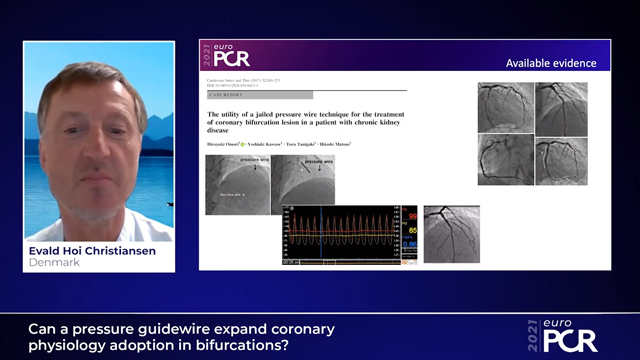
EBC MAIN overview and the impact on clinical practice
18 May 2021 – From EuroPCR 2021
Watch this session presented by David Hildick-Smith, Jens Flensted Lassen and Goran Stankovic in order to learn more about this important study and understand the impact to clinical practice, to gain insights from an interesting EBC main case, and to listen to the expert's perspectives on other recent...
Shock the Rock: new intravascular lithotripsy real-world data and cases
18 May 2021 – From EuroPCR 2021
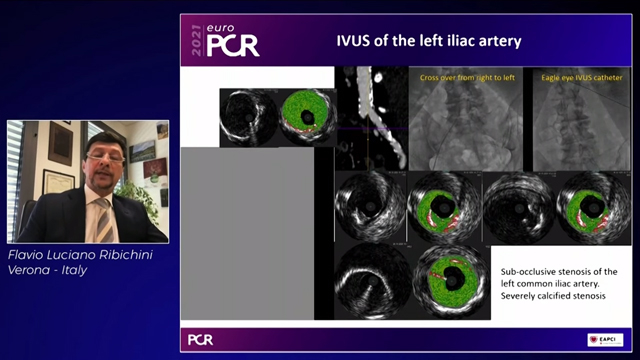
Watch this session presented by Emanuele Barbato, Holger Nef, Arif Al Nooryani, Alfonso Ielasi, Michael Haude, Margaret McEntegart and Flavio Luciano Ribichini in order to learn how to optimally adopt Intravascular Lithotripsy (IVL) for treatment of calcified lesions, to identify best practices when using IVL in different clinical settings,...
EBC Main: Behind the curtain
18 May 2021 – From EuroPCR 2021
Watch this session presented by David Hildick-Smith in order to have additional information about the EBC main trial, to learn about the principal investigator's interpretation of results, and to find out about the European Bifurcation Club's remaining questions to be addressed in future trials.