


3652 results for «322»
3652 results
Innovation in transcatheter mitral valve interventions
21 May 2026 – From EuroPCR 2026
This comprehensive session presents the latest innovations in transcatheter mitral valve interventions, highlighting cutting-edge devices and clinical experiences. Topics include early feasibility studies of novel hemivalve systems, first-in-human experiences with new mitral valve replacement technologies, advances in transcatheter edge-to-edge repair (TEER) with one-year outcome data, and...

Insight from new evidence for complex PCI: value of imaging (CHIP IVUS) and left ventricular support (CHIP BCIS 3)
21 May 2026 – From EuroPCR 2026
This session reviews the impact of recent evidence on complex PCI, highlighting the value of intracoronary imaging (CHIP IVUS trial) and left ventricular assist devices (CHIP BCIS 3 trial). Through case discussions, participants reflect on how these innovations influence daily clinical practice and enhance procedural planning...

Devices and strategies in calcified lesions
21 May 2026 – From EuroPCR 2026
Explore advanced devices and techniques for treating calcified coronary lesions in this session. Discussions include the use of Eximer laser coronary atherectomy, novel cutting balloons, outcomes of rotational atherectomy in tortuous vessels, atherectomy combined with drug-coated balloon therapy, and calcium fracture patterns following Shockwave intravascular lithotripsy.
Challenging cases in calcified lesions PCI
22 May 2026 – From EuroPCR 2026
This session addresses challenging cases in PCI of heavily calcified lesions. It covers unexpected complications such as silent shockwave failures, interventions in calcified Kawasaki disease, delayed coronary obstructions post-TAVI, and complex left main bifurcation lesions. The session underscores the perseverance required to successfully navigate these demanding...
TAVI in heart failure is possible
21 May 2026 – From EuroPCR 2026
This session demonstrates the feasibility of transcatheter aortic valve implantation (TAVI) in patients with heart failure through a series of challenging cases. It covers sequential management of hypertrophic obstructive cardiomyopathy with aortic stenosis, advanced heart failure interventions, staged approaches in cardiogenic shock, and complex percutaneous interventions...
Inflammation and cardiovascular risk
21 May 2026 – From EuroPCR 2026
Exploring the interplay between inflammation and cardiovascular risk, this session reviews contemporary research on residual risk post-PCI, inflammatory markers in coronary artery disease especially in type 2 diabetes and ACS, and prognostic tools including lipoprotein(a) and systemic inflammation indices.
Calcified lesions: when one dedicated device is not enough
22 May 2026 – From EuroPCR 2026
This session highlights the need for multiple dedicated devices in the treatment of calcified coronary lesions. It discusses combined orbital and rotational atherectomy techniques, debulking in complex high-risk patients, and the integration of atherectomy with intravascular lithotripsy systems. Emphasis is placed on physiology and imaging-guided approaches...
Overcoming complications with intracoronary imaging
21 May 2026 – From EuroPCR 2026
Explore challenging cases of intracoronary imaging complications, highlighting recognition, management, and resolution of complex vascular and mechanical issues encountered during coronary interventions.
Innovative strategies in STEMI management
22 May 2026 – From EuroPCR 2026
This session presents innovative strategies in STEMI management, including the treatment of acute saphenous vein graft occlusion, primary PCI via the left internal mammary artery, and a two-step lesion debulking approach. It also covers hybrid drug-coated balloon strategies in complex multivessel disease and the emerging role...
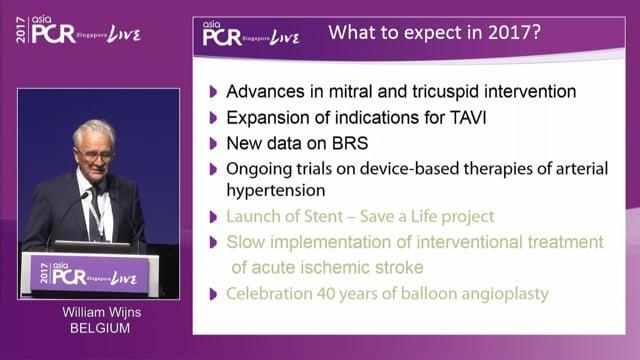
AsiaPCR/SingLIVE 2017: closing Ceremony and Awards
21 Jan 2017 – From AsiaPCR/SingLIVE 2017
Consult the Closing ceremony and awards session from AsiaPCR/SingLIVE 2017, where W. Wijns addresses the subject of what to expect in the field of Interventional Cardiology in 2017, and the speakers present the award winners of this year's best clinical cases namely R. Fukuhara, Japan, W....

Chairperson

Chairperson
Spontaneous coronary artery dissection management with intracoronary imaging
22 May 2026 – From EuroPCR 2026
Explore the nuanced management of spontaneous coronary artery dissection (SCAD) with a focus on intracoronary imaging. This session examines diagnostic challenges, the limited role of coronary CT angiography, and strategies for managing occlusive SCAD cases, highlighting the evolving understanding of this complex condition.
Diversity in coronary artery disease treatment
22 May 2026 – From EuroPCR 2026
Focusing on the diversity in coronary artery disease treatment, this session highlights challenges ranging from maintaining interventional cardiology services during conflict to the influence of comorbidities such as type 2 diabetes mellitus on prognosis and risk assessment. It also presents clinical outcomes related to stent thrombosis...
The microcirculation: the next frontier in coronary practice
18 May 2026 – From EuroPCR 2026
Delve into the complexities of coronary microcirculation and its clinical implications. This session highlighted advanced diagnostic techniques such as bolus and continuous thermodilution, the interpretation of microvascular resistance reserve, and practical guidance on establishing a high-impact ANOCA clinic to manage microvascular angina and coronary dysfunction.
Clinical decision making for CTO PCI strategy
22 May 2026 – From EuroPCR 2026
This session explores clinical decision-making in CTO PCI strategy through complex scenarios including multivessel CTO in ischemic cardiomyopathy, high-risk NSTEMI post-vein graft failure, and challenges in elderly patients. It emphasizes strategic planning and individualized approaches to optimize outcomes.
Once you find microvascular disease, what do you actually do?
18 May 2026 – From EuroPCR 2026
Addressing coronary microvascular disease requires a comprehensive understanding of current medical therapies and emerging interventions. This session reviews state-of-the-art pharmacological treatments, elucidates the mechanisms and clinical data surrounding the coronary sinus reducer (CSR), and offers critical discussion on its therapeutic role in microvascular dysfunction.
Left main PCI-complex procedures
22 May 2026 – From EuroPCR 2026
This session covers complex left main coronary artery PCI procedures that challenge standard algorithms. It includes tackling chronic total occlusions of the left main, managing spontaneous coronary artery dissection in patients on ECMO, handling stent dislodgement, and addressing complex trifurcation lesions, providing comprehensive insights into advanced...
Atypical NSTEMI culprit lesions
22 May 2026 – From EuroPCR 2026
Focusing on atypical NSTEMI culprit lesions, this session examines rare presentations such as calcific emboli, coronary anomalies, and unusual routes to revascularisation. It provides clinical insights into diagnosing and managing uncommon acute coronary syndromes effectively.
The physiological mindset: foundations every modern operator must own
18 May 2026 – From EuroPCR 2026
This session delves into the fundamental principles governing coronary blood flow regulation, emphasizing coronary autoregulation and the influence of epicardial haemodynamics on vascular morphology. Participants deepen their understanding of coronary physiology beyond formulas, exploring the intersection of physiology and atherosclerosis.
Physiology in the real world: how to measure, when to trust it, what to do?
18 May 2026 – From EuroPCR 2026
This session provides comprehensive insights into coronary physiology assessment tools, emphasizing techniques for reliable haemodynamic measurements and exploring clinical considerations surrounding coronary spasms and myocardial bridges.
Closing lectures
18 May 2026 – From EuroPCR 2026
This session presents comprehensive closing lectures focusing on the evolving understanding of coronary microvascular dysfunction, examining the balance between vulnerability and physiology, and outlining future priorities for next-generation cathlab practices. It concludes with a session evaluation and synthesis of key learnings to inform clinical practice.