


05 Jun 2026
Future directions in LAA Closure - SIMPLAAFY, CATALYST and LAAOS IV
Shaping the future: the evolving LAAC landscape
In this article, Marek Grygier reviews the rapidly evolving landscape of LAAC. Building on recent landmark trials such as OPTION and CHAMPION‑AF, he explores how emerging evidence is reshaping the role of device-based stroke prevention in atrial fibrillation. He also highlights ongoing studies, including SIMPLAAFY, CATALYST and LAAOS IV, that are expected to further define the future of LAAC, from simplifying post-procedural therapy to expanding indications and combining strategies.

The field of left atrial appendage closure (LAAC) is currently undergoing a profound transformation. For many years, transcatheter LAA closure was primarily reserved for patients with atrial fibrillation (AF) who had contraindications to long-term oral anticoagulation (OAC). However, recent landmark randomised trials, particularly OPTION and CHAMPION-AF, have significantly expanded the evidence base and may ultimately redefine the role of LAAC in stroke prevention. The OPTION trial demonstrated that LAA closure following AF ablation was associated with a significant reduction in non-procedural major and clinically relevant non-major bleeding compared with continued anticoagulation, while maintaining similar protection against stroke, systemic embolism, and death. These findings challenged the long-standing paradigm that successful AF ablation must be followed by life-long anticoagulation in high-risk patients. Even more importantly, the recently presented CHAMPION-AF trial extended the comparison beyond post-ablation patients. In this large randomised study, LAA closure was shown to be non-inferior to direct oral anticoagulants (DOACs) for prevention of stroke, systemic embolism, and cardiovascular death, while offering a significant reduction in long-term bleeding events. For the first time, a device-based strategy demonstrated outcomes comparable to contemporary anticoagulation in patients who were otherwise suitable candidates for DOAC therapy.
These studies suggest that LAA closure may evolve from an alternative treatment for selected patients into a frontline stroke prevention strategy for broader AF populations. Nevertheless, several important questions remain unanswered, and ongoing trials are expected to shape the next phase of this evolution.
SIMPLAAFY: Simplifying Post-Implant Antithrombotic Therapy
One of the major limitations of current LAAC practice remains the need for post-procedural antithrombotic therapy. Although device implantation eliminates the need for lifelong anticoagulation in most patients, the optimal regimen during endothelialisation remains uncertain. The SIMPLAAFY trial is designed to evaluate whether simplified post-implant monotherapy strategies can safely replace the currently used dual antiplatelet therapy (DAPT). Patients receiving the WATCHMAN FLX Pro device are randomised to aspirin monotherapy, reduced-dose DOAC monotherapy, or conventional DAPT. The primary objective is to determine whether these simplified approaches can maintain protection against stroke and device-related thrombosis while reducing bleeding complications. A positive result would represent a major step forward, particularly for elderly and frail patients, and could further improve the safety profile of LAA closure.
CATALYST: The Next Head-to-Head Comparison With DOACs
Following the encouraging findings from CHAMPION-AF, additional randomised evidence comparing LAA closure with modern anticoagulation remains essential. The CATALYST trial is evaluating the Amplatzer Amulet device against guideline-directed NOAC therapy in patients with AF and elevated stroke risk. The study incorporates several co-primary endpoints, including prevention of ischemic stroke, systemic embolism, cardiovascular death, and major bleeding. Importantly, patients will be followed for up to five years, providing critical long-term data regarding durability and safety. If CATALYST confirms the results observed in CHAMPION-AF, the field may witness a paradigm shift in which device-based stroke prevention becomes a realistic alternative to lifelong anticoagulation for a much larger population of patients with atrial fibrillation.
LAAOS-IV: Combining Occlusion With Anticoagulation
While OPTION and CHAMPION-AF evaluate LAA closure as an alternative to anticoagulation, LAAOS-IV addresses a different and highly intriguing question: can LAA occlusion provide additional protection when combined with ongoing anticoagulation? The rationale stems from the highly successful LAAOS III trial, which demonstrated that surgical left atrial appendage occlusion performed during cardiac surgery reduced stroke risk despite continued anticoagulation. LAAOS-IV extends this concept to a percutaneous approach. The trial is investigating whether catheter-based LAA closure added to standard oral anticoagulation can further reduce ischemic stroke and systemic embolism in very high-risk AF patients who remain vulnerable despite optimal medical therapy. Participants typically have advanced stroke risk profiles and continue anticoagulation throughout follow-up. Should the trial prove positive, it could establish an entirely new treatment paradigm: LAA closure not as a substitute for anticoagulation, but as an adjunctive therapy for patients at exceptionally high thromboembolic risk.
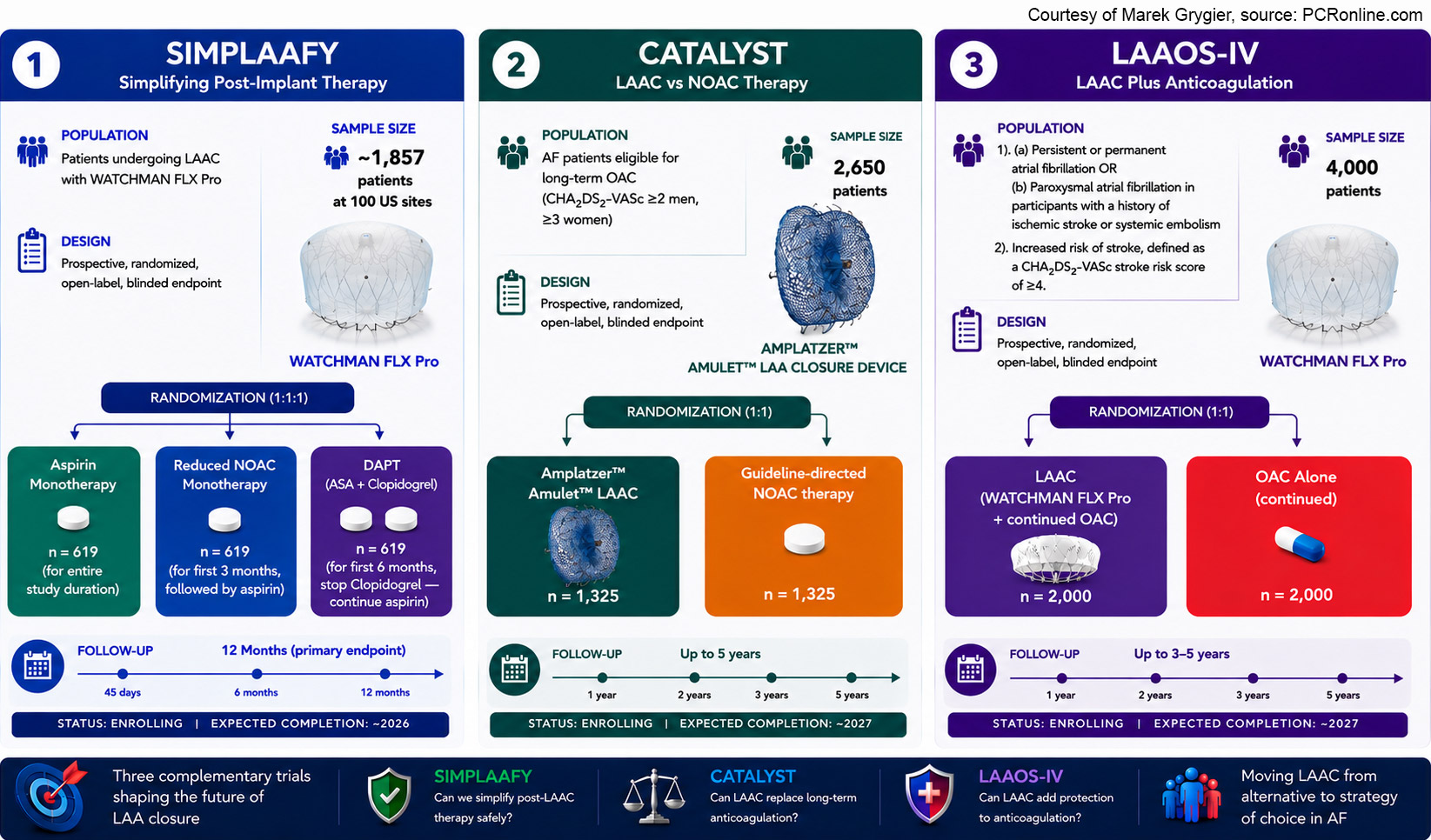
SIMPLAAFY, CATALYST, LAAOS-IV: Three complementary trials shaping the future of LAA closure
Courtesy of Marek Grygier, source: PCRonline.com
Conclusion
The publication of OPTION and CHAMPION-AF marks the beginning of a new era in left atrial appendage closure. The focus of research is rapidly shifting from demonstrating feasibility and safety toward defining the optimal role of LAAC across the entire spectrum of atrial fibrillation management. SIMPLAAFY aims to simplify post-procedural therapy, CATALYST seeks to strengthen evidence against contemporary anticoagulation, and LAAOS-IV explores whether combining LAA closure with anticoagulation can further reduce residual stroke risk. Together, these studies may determine whether LAA closure becomes not only an alternative to oral anticoagulation, but also a central component of future stroke prevention strategies in atrial fibrillation.
