


Sirolimus-Eluting Balloon vs. Repeat Drug-Eluting Stent or Balloon Angioplasty for Coronary In-Stent Restenosis
Selected in JACC by J. Andréka , N. Ryan
Instent restenosis remains the Achilles heel of PCI. Drug eluting balloons offer a potential strategy for the treatment of instent restenosis. To date implantation of a further drug eluting stent provide better long term outcomes compared to paclitaxel drug eluting balloons. In this trial the authors compare the safety and efficacy of sirolimus drug eluting balloon to usual care in patients with ISR.
References
Authors
Donald E. Cutlip, Roxana Mehran, Samin Sharma, Gheorghe Doros, Brian Jefferson, Giulio Stefanini, Suhail Dohad, Antoinette Neylon, Itsik Ben-Dor, Dwijesh Patel, Bassem M. Chehab, Anay Pradhan, Roberto Nerla, Pascal Vranckx, Marie-France Poulin, Allen Jeremias, Eric A. Osborn, and Ron Waksman the SELUTION4ISR Investigators
Published
15 April 2026
Link
Read the abstractReviewers


Our Comment
Why this study – the rationale/objective?
Despite improvements in stent platform technology instent restenosis (ISR) remains a significant clinical concern. There are several potential strategies for treatment of ISR including implantation of further drug eluting stents which provides good clinical and angiographic results and the use of drug eluting balloons which deliver antiproliferative therapy whilst avoiding the addition of a further layer of stent in the vessel(1). Current guidelines(2) recommend the use of DES in ISR predominantly due to better long term outcomes with everolimus eluting stents compared to paclitaxel eluting balloons(3). In this study the authors aimed to establish the safety and efficacy of PCI with a contemporary sirolumus eluting balloon compared to standard of care (PCI with DES or POBA) for ISR.
How was it executed? The methodology
Patients undergoing PCI for ISR within a prior BMS or DES in a native coronary artery were eligible for inclusion, ≥ 2 layers of stent within the target lesion was a key exclusion criteria. Satisfactory lesions preparation, <30% stenosis and no more than type C dissection, was required prior to randomisation. Patients were randomised to treatment with the SELUTION Sustained Limus Release (SLR) Drug-Eluting Balloon or standard of care PCI with an everolimus or zoterolimus DES or balloon angioplasty. Operator strategy in terms of DES or BA was declared prior to randomisation with selected use of BA stopped after recruitment of 20% of the projected enrolment to approximate standard care in the US. Intravascular imaging was required post preparation, pre-treatment to assess vessel size and confirm stent expansion.
- The primary endpoint was TLF, including cardiac death, target-vessel myocardial infarction, or clinically indicated target-lesion revascularisation at 12 months.
- Secondary endpoints included, the components of the primary endpoint and safety endpoints of stent or lesion thrombosis and bleeding.
- The primary analysis was carried out in the per-protocol group.
- A prespecified secondary analysis compared DEB with DES in patients with single-layer ISR
What is the main result?
Between July 2020 and July 2024, a total of 1508 patients in 48 sites across 7 countries were screened with the majority (716) excluded due to absence of an eligible lesion at the time of angiography. Following successful lesion preparation 418 patients were randomized to either a sirolimus eluting balloon-based strategy (210) or standard of care with DES or BA (208). Following exclusion of protocol violations 390 patients remained in the per-protocol analysis (DEB=197; control= 193). The majority of patients, 78%, were male with a median age of 69 years, traditional CVRF were common with >40% having diabetes. Over a fifth of the population had two prior layers of stent.
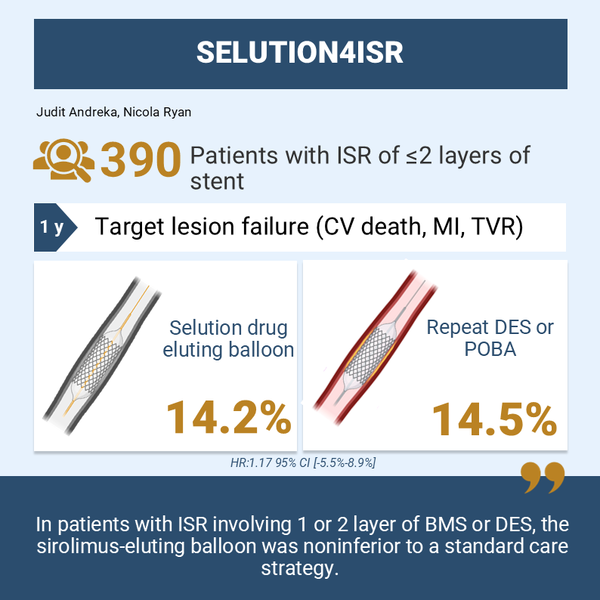
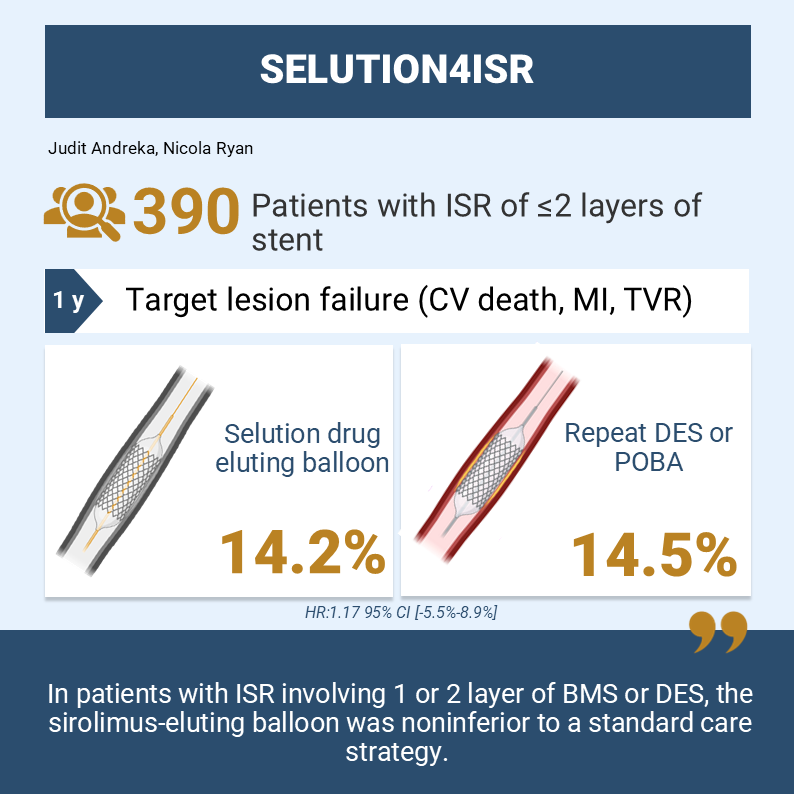
- Target lesion failure occurred in 16.2 % of patients in the DEB group and 14.5 % in the control group meeting non-inferiority criteria
- absolute difference 1.7 %; 95 % CI -5.5% to 8.9% posterior probability of noninferiority: 98.80%
- There were no significant differences in the secondary endpoints of death, MI, TLR stent thrombosis and bleeding between groups.
- In the prespecified secondary analysis of DEB vs DES among patients with single-layer ISR, TLF occurred in 14.2% in the DEB group and in 6.5% in the DES group, failing to meet non-inferiority criteria
- absolute difference: 7.7%; 95% CI: 0.6%-14.6%; posterior probability for noninferiority: 76.07%
Critical reading and the relevance for clinical practice
The results of the SELUTION4ISR trial demonstrate that PCI with a sirolimus-eluting balloon is non inferior to standard of care in patient with ISR in terms of TLR at one year. In a pre-specified secondary analysis the sirolimus eluting balloon was not non-inferior to PCI with a drug eluting stent in patients with one prior layer of stent.
Instent restenosis remains the Achilles heel of PCI and despite evolution of stent technology remains challenging to treat due to the risk of recurrence, commonly presenting with acute coronary syndrome which is associated with important morbidity and mortality. Furthermore, there are several different underlying mechanisms of ISR including stent related such as underexpansion or undersizing, fracture, geographic miss as well as biological including neoatherosclerosis or neointimal hyperplasia which can exist in combination. Whilst intracoronary imaging was recommended and carried out in 98% of cases prior treatment the authors have not included the mechanisms of stent failure in this study. Understanding the underlying mechanism of stent failure may help to target optimal treatment in future trials.
The results in the single layer stent demonstrating the good performance of a DES is in keeping with the results from RIBS V(4) and the DAEDALUS meta-analysis(5) which lead to the current guidelines. Importantly the study was underpowered for comparisons between a prior single or double layer of stent however all treatment had a higher risk of recurrence for 2-layer ISR. Whilst this study demonstrated the overall non-inferiority of this sirolimus DEB, drug eluting balloon there are no class effects with drug eluting ballons due to differences in drug formulation and excipients therefore these results cannot be generalised outwith this specific device.
Patients with ISR represent an important technical challenge for interventional cardiologists and when approaching the treatment one must consider the lifetime management of these lesions due to the risk of recurrence. In patients with a single prior layer of stent a DES is the current guideline recommended treatment and this trial supports this strategy. However as with all treatments this must be individualised to the patient and there does not appear to be a safety penalty with the use of drug eluting stents. Future studies using intracoronary imaging to identify the mode of stent failure may allow stratified treatment.
References
- Siontis GCM, Stefanini GG, Mavridis D, Siontis KC, Alfonso F, Pérez-Vizcayno MJ, et al. Percutaneous coronary interventional strategies for treatment of in-stent restenosis: a network meta-analysis. The Lancet. 2015 Aug 15;386(9994):655–64. doi:10.1016/S0140-6736(15)60657-2
- Vrints C, Andreotti F, Koskinas KC, Rossello X, Adamo M, Ainslie J, et al. 2024 ESC Guidelines for the management of chronic coronary syndromes: Developed by the task force for the management of chronic coronary syndromes of the European Society of Cardiology (ESC) Endorsed by the European Association for Cardio-Thoracic Surgery (EACTS). Eur Heart J. 2024 Sep 21;45(36):3415–537. doi:10.1093/eurheartj/ehae177
- Elgendy IY, Mahmoud AN, Elgendy AY, Mojadidi MK, Elbadawi A, Eshtehardi P, et al. Drug-Eluting Balloons Versus Everolimus-Eluting Stents for In-Stent Restenosis: A Meta-Analysis of Randomized Trials. Cardiovascular Revascularization Medicine. 2019 Jul 1;20(7):612–8. doi:10.1016/j.carrev.2018.08.010
- Alfonso F, Pérez-Vizcayno MJ, Cárdenas A, García Del Blanco B, Seidelberger B, Iñiguez A, et al. A randomized comparison of drug-eluting balloon versus everolimus-eluting stent in patients with bare-metal stent-in-stent restenosis: the RIBS V Clinical Trial (Restenosis Intra-stent of Bare Metal Stents: paclitaxel-eluting balloon vs. everolimus-eluting stent). J Am Coll Cardiol. 2014 Apr 15;63(14):1378–86. doi:10.1016/j.jacc.2013.12.006 PubMed PMID: 24412457.
- Giacoppo D, Alfonso F, Xu B, Claessen BEPM, Adriaenssens T, Jensen C, et al. Paclitaxel-coated balloon angioplasty vs. drug-eluting stenting for the treatment of coronary in-stent restenosis: a comprehensive, collaborative, individual patient data meta-analysis of 10 randomized clinical trials (DAEDALUS study). Eur Heart J. 2020 Oct 7;41(38):3715–28. doi:10.1093/eurheartj/ehz594 PubMed PMID: 31511862; PubMed Central PMCID: PMC7706792.

No comments yet!