


DAPT-MVD: extended dual antiplatelet therapy for multivessel coronary artery disease
Selected in The New England Journal of Medicine by A. Sticchi
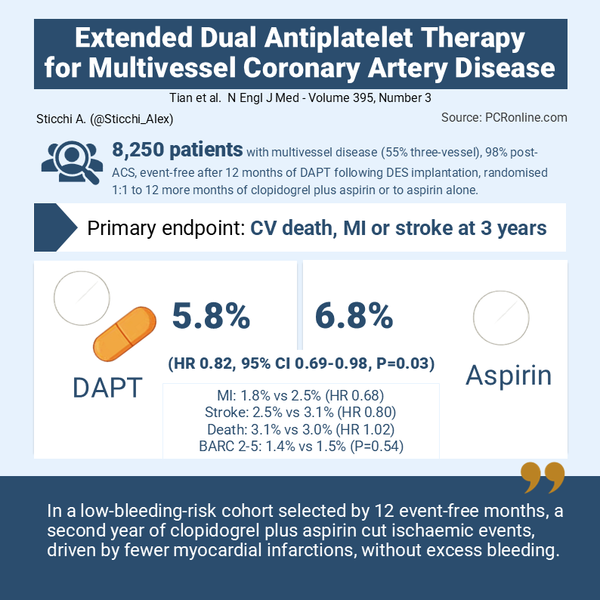
In patients with multivessel disease who were event-free 12 months after drug-eluting stent implantation, a further 12 months of clopidogrel plus aspirin reduced ischaemic events compared with aspirin monotherapy, with no detectable excess of adjudicated bleeding.
References
Authors
Tian J, Wang Z, Wang Y, et al., Mintz GS, Wang D, Stone GW, Yu B, for the DAPT-MVD Trial Investigators
Reference
N Engl J Med 2026;395:233-42 - DOI: 10.1056/NEJMoa2517588
Published
Published July 15, 2026
Link
Read the abstractReviewer

My Comment
Why this study – the rationale/objective?
Antiplatelet strategy after percutaneous coronary intervention (PCI) has moved towards shorter dual antiplatelet therapy (DAPT) and de-escalation, and extension beyond 12 months is currently a conditional option, designated Class 2b in the 2023 AHA/ACC chronic coronary disease guideline with comparable conditional status in European guidance1,2.
Patients with multivessel disease represent a possible exception, since natural history studies indicate that a substantial proportion of subsequent events arise from untreated, angiographically non-obstructive plaque rather than from the stented segment3,4.
Earlier extended DAPT trials, including DAPT and PEGASUS-TIMI 54, demonstrated ischaemic benefit offset by increased bleeding, and none was designed around multivessel anatomy5,6.
DAPT-MVD was undertaken to determine whether, in a dedicated multivessel population that had already tolerated one year of DAPT, a further 12 months of clopidogrel plus aspirin would reduce ischaemic events compared with aspirin monotherapy without a corresponding haemorrhagic cost.
How was it executed? The methodology
DAPT-MVD was an open-label, assessor-blinded (PROBE) randomised trial conducted at 97 centres in China under the oversight of the Chinese Society of Cardiology. Eligible patients were 18 to 75 years of age with multivessel disease, defined as at least two major epicardial vessels with diameter stenosis of 50% or more and left main stenosis no greater than 30%, who had completed 12 months of DAPT after drug-eluting stent implantation without major ischaemic or bleeding events. Exclusion criteria included planned anticoagulation, planned revascularisation, and any prior ischaemic stroke or intracranial haemorrhage.
At a mean of 379 days after PCI, 8,250 patients were randomised 1:1 to clopidogrel 75 mg plus aspirin 75 to 150 mg daily or to aspirin alone for a further 12 months, after which therapy reverted to physician discretion. Follow-up was scheduled at 1, 3, 6, 9, 12 and 36 months, and a blinded clinical events committee adjudicated all endpoints.
The primary efficacy endpoint was a composite of cardiovascular death, nonfatal myocardial infarction or nonfatal stroke; the primary safety endpoint was BARC type 2 or higher bleeding. The trial was powered at 80% to detect a hazard ratio of 0.80. Analysis was by intention to treat using an unadjusted Cox model, without interim analysis and without multiplicity adjustment for secondary endpoints.
What is the main result?
The cohort was young (mean age 60.5 years) and lean (mean BMI 25.3), with 30.3% women and 28.2% with diabetes; 98.3% had presented with an acute coronary syndrome and 53% to 55% had three-vessel disease. PCI had been performed on a single vessel in 79.5% of patients. Median follow-up was 34.3 months, with 1.8% lost to follow-up.
The primary endpoint occurred in 222 patients (36-month estimate 5.8%) versus 266 (6.8%): hazard ratio 0.82 (95% CI 0.69 to 0.98; P = 0.03), corresponding to an absolute reduction of approximately 1.0% and a number needed to treat close to 100 (win ratio 1.22, 95% CI 1.01 to 1.46). Among the components, only nonfatal myocardial infarction reached nominal significance (1.8% versus 2.5%; HR 0.68, 95% CI 0.50 to 0.93). Stroke was not significantly reduced (HR 0.80, 95% CI 0.61 to 1.04), net adverse clinical events did not differ (HR 0.85, 95% CI 0.72 to 1.01), and mortality was unchanged (all-cause HR 1.02; cardiovascular HR 0.96).
BARC 2 to 5 bleeding occurred in 1.4% versus 1.5% (HR 0.89, 95% CI 0.61 to 1.30) and BARC 3 to 5 bleeding in 0.8% versus 0.9% (HR 0.87, 95% CI 0.53 to 1.43).
Two post-hoc analyses are relevant to interpretation. A landmark analysis yielded hazard ratios of 0.87 for months 0 to 12, 0.64 for months 12 to 24 and 0.90 beyond 24 months. Myocardial infarctions occurring within the first 24 months arose predominantly from nontarget vessels (9 versus 32).
Critical reading and the relevance for clinical practice
DAPT-MVD is a large, well-conducted, investigator-led trial addressing a clinically relevant question in an under-represented population, and the primary result is formally positive. Several considerations bear on its interpretation and on the applicability of the findings to real-world practice.
The comparator
The principal methodological consideration concerns the comparator. The trial compared aspirin plus clopidogrel with aspirin alone and therefore cannot separate the contribution of adding a P2Y12 inhibitor from that of substituting clopidogrel for aspirin. In the same clinical setting, namely patients who are event-free after a standard course of DAPT following PCI, the comparative evidence favouring clopidogrel monotherapy over aspirin monotherapy has become substantial and internally consistent. SMART-CHOICE 3 reported a hazard ratio of 0.71 (95% CI 0.54 to 0.93) for death, myocardial infarction or stroke, driven by myocardial infarction and without excess bleeding7. The 10-year follow-up of HOST-EXAM confirmed a durable advantage for clopidogrel (HR 0.86, 95% CI 0.77 to 0.96), with lower ischaemic and lower bleeding event rates8, and both the individual patient data meta-analysis by Valgimigli and colleagues and the earlier PANTHER analysis reached concordant conclusions9,10.
The effect size observed in DAPT-MVD (HR 0.82) falls within this range. The benefit may therefore reflect the recognised limitations of aspirin as a long-term single agent rather than an incremental effect of dual therapy. A three-arm design incorporating clopidogrel monotherapy would have resolved this question directly. The distinction carries practical weight, since clopidogrel monotherapy achieves a comparable ischaemic reduction while avoiding aspirin-related gastrointestinal toxicity, and the 2024 ESC chronic coronary syndromes guideline already recognises clopidogrel as a reasonable alternative to aspirin for long-term monotherapy11.
Temporal pattern of the treatment effect and statistical margin
The landmark analysis is interpreted by the investigators as evidence of a legacy effect on untreated plaque, and its temporal distribution merits attention. The treatment effect was not statistically evident during the 12 months in which the randomised regimens were administered (HR 0.87, 95% CI 0.65 to 1.16). It reached significance during months 12 to 24 (HR 0.64, 95% CI 0.45 to 0.92), a period in which patients in both arms were predominantly receiving aspirin monotherapy, and was no longer apparent thereafter (HR 0.90, 95% CI 0.68 to 1.19). An effect that emerges after cessation of the randomised regimen is difficult to attribute to the intervention with confidence. Plaque stabilisation mediated by P2Y12 receptor inhibition is biologically plausible and supported by preclinical work, but random variation within an unpowered post-hoc partition remains an alternative explanation, and the analysis is appropriately regarded as hypothesis-generating.
The primary result also rests on a narrow margin: 44 excess events among 8,250 patients, an absolute reduction of approximately 1.0% at three years, an upper confidence bound of 0.98 and a win ratio lower bound of 1.01. Only one component of the composite reached nominal significance, confidence intervals for secondary endpoints were not adjusted for multiplicity, net adverse clinical events did not differ significantly, and mortality was unaffected (HR 1.02).
Reclassification of a small number of events would alter the statistical conclusion. The reversal of the point estimate in patients with BMI of 28 or more (HR 1.12, 95% CI 0.67 to 1.87) is consistent with reduced clopidogrel responsiveness in obesity, although interaction testing was not reported.
Ascertainment of bleeding
The absence of an excess bleeding signal warrants careful reading, since the absolute event rates are low by contemporary standards. A 36-month cumulative incidence of BARC 2 to 5 bleeding of 1.4% to 1.5% compares with 4.6% at one year on aspirin plus ticagrelor in ULTIMATE-DAPT12. Two aspects of the design bear on ascertainment. Follow-up contacts were scheduled through 12 months and then at 36 months, so events occurring over a 24-month interval were captured retrospectively at a single visit, and 37.3% of patients reached that window. In addition, the supplementary safety data do document a pharmacological effect: BARC type 1 bleeding was more frequent with extended DAPT (19.8% versus 17.6%, P = 0.01), as were subcutaneous haemorrhage (1.9% versus 1.0%), vascular disorders as a system organ class (7.4% versus 4.8%) and adverse events attributed to study medication (14.6% versus 11.9%), all with P < 0.001. The safety finding is therefore best expressed as no detectable increase in adjudicated clinically relevant bleeding within the constraints of this ascertainment strategy.
Population characteristics and applicability
Three characteristics of the population bear on applicability. The cohort was entirely Chinese and 98.1% Han. CYP2C19 loss-of-function alleles are carried by a majority of East Asian patients and reduce clopidogrel bioactivation13, and neither genotyping nor platelet function testing was performed. The implications are bidirectional: reduced platelet inhibition may have attenuated efficacy, in which case the effect in Western populations could be greater, but it may equally have limited bleeding, in which case the safety profile may not be reproduced. The lean phenotype is consistent with the latter possibility.
Enrolment was also weighted towards low bleeding risk, with an age limit of 75 years and exclusion of anticoagulation and of any prior ischaemic stroke or intracranial haemorrhage. The dissociation between ischaemic benefit and bleeding risk may therefore reflect the enrichment strategy as much as any property of the regimen itself, and the findings do not extend to the older, comorbid or anticoagulated patients in whom the decision is most difficult. This is pertinent because strokes outnumbered myocardial infarctions in the trial (217 versus 164 adjudicated events), a distribution uncommon in coronary trials, and long-term dual antiplatelet therapy has not demonstrated benefit in cerebrovascular prevention14,15.
A third consideration concerns the anatomy. Multivessel disease was defined angiographically, intracoronary physiology was used in 0.2% of patients and intravascular imaging in approximately 14%, and 79.5% underwent single-vessel PCI. The population therefore consists largely of angiographically defined, incompletely revascularised disease. The mechanistic account is internally consistent, since the benefit was concentrated in nontarget vessels, although it derives from a post-hoc stratification with small numbers and a substantial proportion of events of undetermined location. Given the trend towards physiology-guided complete revascularisation16,17, whether prolonged P2Y12 inhibition retains benefit once the residual ischaemic burden has been addressed mechanically remains untested.
Guideline context
The introduction refers to a Class 1A recommendation for extended DAPT in selected patients at high ischaemic risk. This characterisation merits clarification: the Class 1 recommendation applies to the default 12-month duration after acute coronary syndrome, whereas extension beyond 12 months is designated Class 2b1,2,18. The distinction defines the evidentiary threshold relevant to this trial, which is a possible move from Class 2b towards 2a rather than confirmation of an existing Class 1.
Implications for practice
Three observations are of practical value. The first is epidemiological: a three-year event rate of 6.8% in patients who were by design stable, event-free, non-elderly and receiving optimal medical therapy, with 5.8% still experiencing a major ischaemic event on extended DAPT, documents a residual risk that antiplatelet intensification alone did not eliminate. Further gains in this population are likely to derive from lipid lowering, anti-inflammatory therapy and completeness of revascularisation19.
Second, in a carefully selected patient with extensive and incompletely revascularised multivessel disease, an acute coronary syndrome index event and demonstrated tolerance of 12 months of DAPT, continuation of P2Y12 inhibition into the second year is a reasonable and apparently safe option. Third, the trial does not establish that aspirin should be the accompanying agent. In light of HOST-EXAM, SMART-CHOICE 3 and the individual patient data meta-analyses, a switch to clopidogrel monotherapy is supported at least as strongly as continuation of both agents, with a plausibly lower bleeding burden. A direct comparison of extended DAPT with clopidogrel monotherapy in multivessel disease would address the remaining uncertainty. In the interim, DAPT-MVD is most usefully read as evidence against long-term aspirin monotherapy rather than as support for two years of dual therapy.
References
- Virani SS, Newby LK, Arnold SV, et al. 2023 AHA/ACC/ACCP/ASPC/NLA/PCNA guideline for the management of patients with chronic coronary disease. Circulation. 2023;148(9):e9-e119.
- Byrne RA, Rossello X, Coughlan JJ, et al. 2023 ESC Guidelines for the management of acute coronary syndromes. Eur Heart J. 2023;44:3720-826.
- Stone GW, Maehara A, Lansky AJ, et al. A prospective natural-history study of coronary atherosclerosis (PROSPECT). N Engl J Med. 2011;364:226-35.
- Erlinge D, Maehara A, Ben-Yehuda O, et al. Identification of vulnerable plaques and patients by intracoronary near-infrared spectroscopy and ultrasound (PROSPECT II). Lancet. 2021;397:985-95.
- Mauri L, Kereiakes DJ, Yeh RW, et al. Twelve or 30 months of dual antiplatelet therapy after drug-eluting stents. N Engl J Med. 2014;371:2155-66.
- Bonaca MP, Bhatt DL, Cohen M, et al. Long-term use of ticagrelor in patients with prior myocardial infarction (PEGASUS-TIMI 54). N Engl J Med. 2015;372:1791-800.
- Choi KH, Park YH, Lee JY, et al. Efficacy and safety of clopidogrel versus aspirin monotherapy in patients at high risk of subsequent cardiovascular event after percutaneous coronary intervention (SMART-CHOICE 3). Lancet. 2025;405:1252-63.
- Koo BK, Kang J, Park KW, et al. Aspirin versus clopidogrel for chronic maintenance monotherapy after percutaneous coronary intervention: 10-year follow-up of the HOST-EXAM trial. Lancet. 2026;407. DOI: 10.1016/S0140-6736(26)00422-8.
- Valgimigli M, Choi KH, Giacoppo D, et al. Clopidogrel versus aspirin for secondary prevention of coronary artery disease: a systematic review and individual patient data meta-analysis. Lancet. 2025;406:1091-102.
- Gragnano F, Mehran R, Branca M, et al. P2Y12 inhibitor monotherapy or dual antiplatelet therapy after coronary revascularisation (PANTHER). J Am Coll Cardiol. 2023;82:89-105.
- Vrints C, Andreotti F, Koskinas KC, et al. 2024 ESC Guidelines for the management of chronic coronary syndromes. Eur Heart J. 2024;45:3415-537.
- Ge Z, Kan J, Gao X, et al. Ticagrelor alone versus ticagrelor plus aspirin from month 1 to month 12 after percutaneous coronary intervention in patients with acute coronary syndromes (ULTIMATE-DAPT). Lancet. 2024;403:1866-78.
- Wang Y, Zhao X, Lin J, et al. Association between CYP2C19 loss-of-function allele status and efficacy of clopidogrel. JAMA. 2016;316:70-8.
- Diener HC, Bogousslavsky J, Brass LM, et al. Aspirin and clopidogrel compared with clopidogrel alone after recent ischaemic stroke or transient ischaemic attack (MATCH). Lancet. 2004;364:331-7.
- Benavente OR, Hart RG, McClure LA, et al. Effects of clopidogrel added to aspirin in patients with recent lacunar stroke (SPS3). N Engl J Med. 2012;367:817-25.
- Mehta SR, Wood DA, Storey RF, et al. Complete revascularization with multivessel PCI for myocardial infarction (COMPLETE). N Engl J Med. 2019;381:1411-21.
- Biscaglia S, Guiducci V, Escaned J, et al. Complete or culprit-only PCI in older patients with myocardial infarction (FIRE). N Engl J Med. 2023;389:889-98.
- Rao SV, O'Donoghue ML, Ruel M, et al. 2025 ACC/AHA/ACEP/NAEMSP/SCAI guideline for the management of patients with acute coronary syndromes. Circulation. 2025;151(13):e771-e862.
- Nidorf SM, Fiolet ATL, Mosterd A, et al. Colchicine in patients with chronic coronary disease (LoDoCo2). N Engl J Med. 2020;383:1838-47.
- Tian J, Wang Z, Wang Y, et al. Extended dual antiplatelet therapy for multivessel coronary artery disease (DAPT-MVD). N Engl J Med. 2026;395:233-42.
No comments yet!