309 results
Five-year outcomes of the randomised trial of fractional flow reserve guided PCI compared to coronary artery bypass grafting: FAME 3
02 Apr 2025
Kalaivani Mahadevan provides her take on the five-year outcomes of the FAME 3 trial presented by William F. Fearon at ACC.25 in Chicago.

Author

Angiography-derived fractional flow reserve versus intravascular ultrasound to guide percutaneous coronary intervention in patients with coronary artery disease: the FLAVOUR II trial
29 Mar 2025
Ali Nazmi Calik provides his take on the FLAVOUR II trial presented by Jian-An Wang at ACC.25 in Chicago.

Author

Harmonising optimal strategy for treatment of coronary artery diseases – bleeding risk: HOST-BR
29 Mar 2025
Daniele Giacoppo and Nicola Ammirabile provide their take on the main results of the HOST-BR trial, presented by Hyo-Soo Kim at ACC.25 in Chicago.

Author

Author

Primary and secondary outcomes of the Women's Ischemia Trial to reduce events in non-obstructive coronary artery disease (WARRIOR)
31 Mar 2025
Nicola Ryan provides her take on the WARRIOR trial which was presented by Eileen Handberg at ACC.25 in Chicago.
The manuscript for this trial has not been published and all assumptions are based upon the presentation.

Author
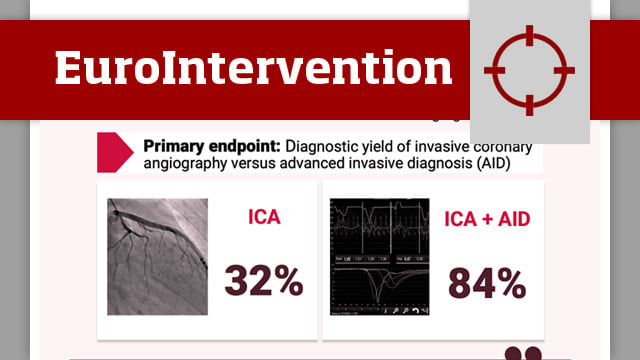
Comprehensive diagnosis in chronic coronary syndromes combining angiography and intracoronary testing: the AID-ANGIO study
18 Feb 2025
The authors hypothesized that enriching invasive coronary angiography (ICA) with an advanced invasive diagnosis (AID) strategy would increase the diagnostic yield of obstructive and non-obstructive coronary artery disease (INOCA).

Reviewer
Reviewer
PCRonline @ ACC.25 Scientific Sessions
07 Feb 2025
Live updates on a selection of major Late Breaking Clinical Trials of interest in interventional cardiology presented at the American College of Cardiology 2025 Scientific Sessions #ACC25
Precision PCI in the era of AI and multimodality imaging
13 Jan 2025
Nailing the ostium of LAD, although technically challenging, can be precisely done with mandatory intracoronary imaging. It is essential to rule out disease extension into left main artery as, otherwise, cross over LM-LAD stenting strategy would be preferable. CTCA can help the interventionist plan the PCI,...

Author

Author

RCA hydraulic dissection: what to do?
06 Jan 2025
Any coronary intervention can be compromised by an iatrogenic hydraulic dissection: find out how to manage it with dissection stenting!

Author

Author

Author

Author

Author

Author
Interventional pot pourri #1
19 Dec 2024 – From GulfPCR-GIM 2024
Dive into this 'Interventional potpourri' session for a diverse array of captivating case studies and innovative techniques in interventional cardiology. Explore an anomalous right coronary artery origin, tackle a complex and poorly understood lesion, discover the integration of artificial intelligence in stentless PCI, and master the...
When complications storm through the cathlab #2
19 Dec 2024 – From GulfPCR-GIM 2024
Brace yourself as we delve into a captivating session showcasing a series of complex and challenging complications that can arise in the catheterization laboratory. From a coiling gone awry to a stuck burr in an elderly patient, this session offers invaluable insights and strategies for navigating...